
Use LinkedIn
for context and first touch. Use email
for follow-up, qualification, and faster back-and-forth. In most
outreach programs, the winning sequence is not “LinkedIn or email.” It is choosing
the right job for each channel so the prospect gets the right message in the
right place.
For
a practical next step, review the prospect
research report workflow before building the outreach sequence.
What
job should LinkedIn do in a sequence?
Native
LinkedIn outreach is best when the buyer needs context before they will
respond. It is a strong first-touch channel because it feels native to the
professional network, and it can make your outreach feel more relevant when the
relationship is still cold.
Use
LinkedIn when you want to:
- Introduce yourself
without asking for much commitment
- Add professional
context before a bigger ask
- Warm a prospect who
may not recognize your name yet
- Follow up in a channel
where the buyer already spends time networking
A
simple way to think about it: LinkedIn
is often the handshake, not the full conversation.
What
job should email do in a sequence?
Email
is usually better for follow-up, qualification, and structured back-and-forth.
It is easier to send, easier to track, and easier for a prospect to reply to
when they are ready to move.
Use
email when you want to:
- Continue the
conversation after a LinkedIn touch
- Ask a direct
qualification question
- Share a clearer offer,
proof point, or CTA
- Move the prospect
toward a meeting, demo, or next step
Email
also gives you more space. That matters when the prospect is evaluating, not just
acknowledging.
Should
LinkedIn or email come first?
That
depends on buyer behavior, not on which channel you personally prefer.
A
practical decision rule:
If
the buyer already has context, email can do the job faster. If they do not,
LinkedIn can help create recognition before the ask gets heavier.
How
should you order LinkedIn and email in a sequence?
A
good sequence is built around progression, not repetition. The second touch
should move the buyer forward, not just repeat the first message in a different
inbox.
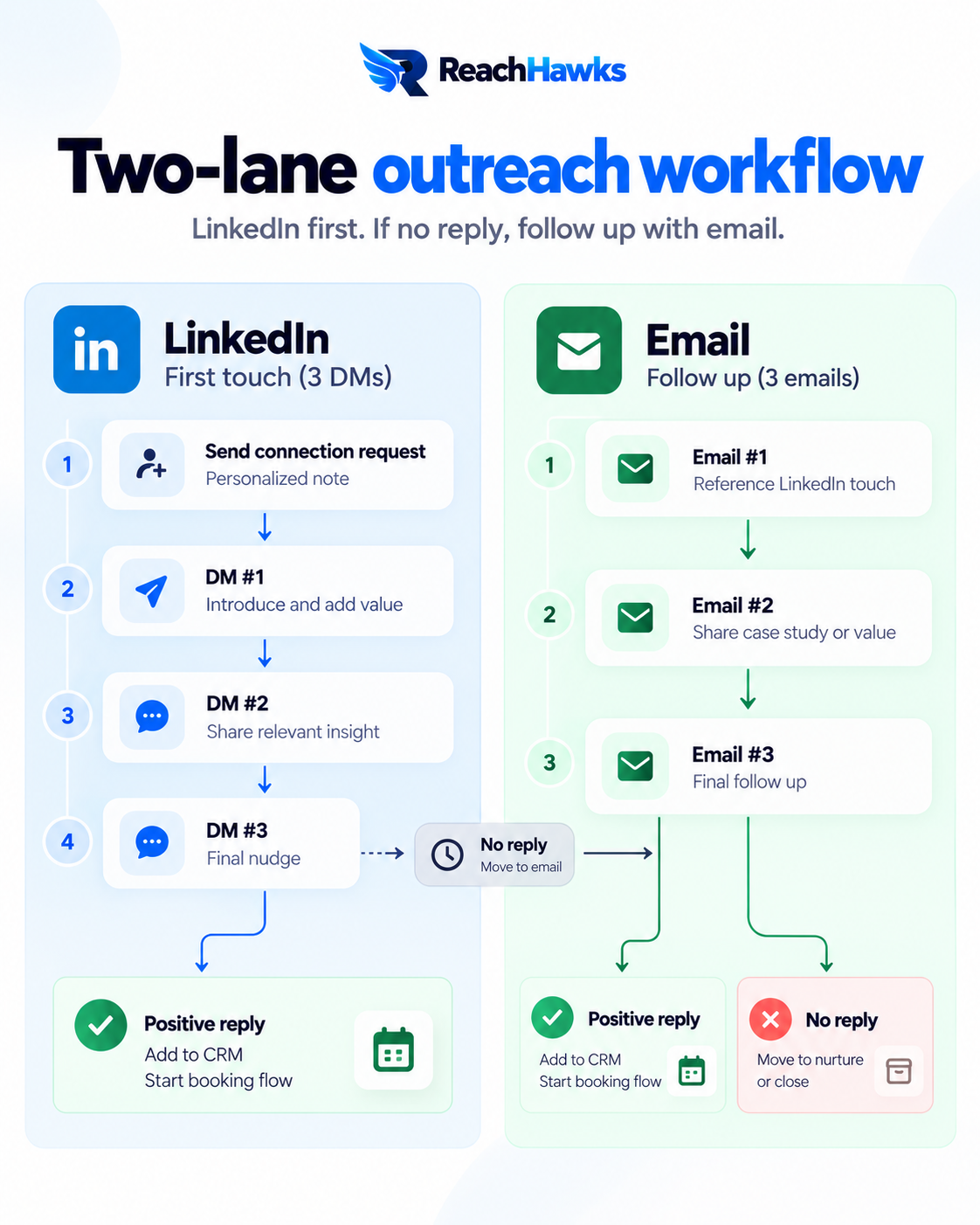
A
simple sequence framework:
- First touch on LinkedIn — short, relevant, low pressure
- Follow-up by email — clearer value, fuller context, direct CTA
- Second LinkedIn touch — reinforce familiarity without sounding robotic
- Email qualification step — ask one concrete question
- Close on the channel where the buyer responds fastest
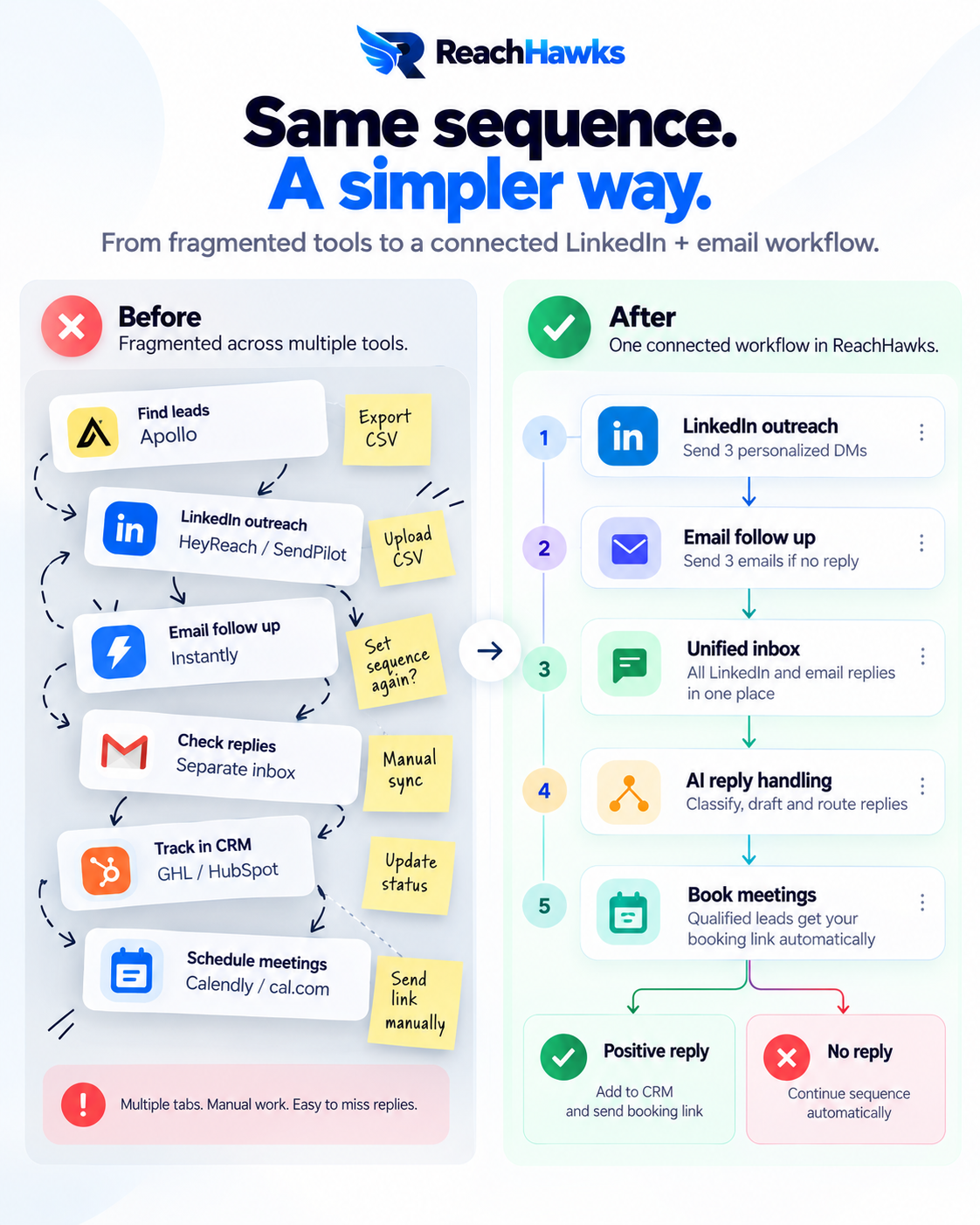
That
is where ReachHawks
fits naturally: it supports email outbound, native LinkedIn outreach, and
connected follow-up in one workflow, so the sequence does not fragment as soon
as someone replies.
What
is the best use case for each channel?
Here
is the plainspoken version.
The
mistake teams make is trying to make one channel do every job. That usually
leads to either overly wordy LinkedIn messages or email sequences that feel
cold and disconnected.
What
are the most common mistakes in LinkedIn sequence management?
Three
mistakes come up again and again:
- Using LinkedIn as if it were email
Long paragraphs, too much detail, too much pressure.
- Using email as if it were LinkedIn
Too much relationship language, not enough clarity.
- Repeating the same message across channels
The prospect sees the same idea twice, but not the next step.
A
better approach is to make each message do one job only. LinkedIn opens the
door. Email makes the door easier to walk through.
What
cadence works best for multi-channel outreach?
There
is no universal cadence, but there is a useful principle: let each touch change
the conversation slightly.
A
simple cadence pattern:
- Day 1: LinkedIn first
touch
- Day 3 or 4: Email
follow-up with a clearer angle
- Day 6 or 7: LinkedIn
nudge or profile-based visibility touch
- Day 9 to 12: Email
qualification or meeting ask
The
exact spacing depends on your audience and offer. Founders often want faster
response cycles. Agencies may prefer a cadence that gives prospects more room
to recognize the brand before the direct ask.
How
do you choose channel order based on buyer behavior?
Choose
order based on what the buyer needs before they say yes.
Use
this framework:
- Need for context is high → start on LinkedIn
- Need for speed is high → start with email
- Need for trust is high → LinkedIn first, email second
- Need for precision is high → email first, LinkedIn as support
- Need for persistence is high → combine both thoughtfully
This
is the real point of sequence strategy: not “which channel wins,” but “which
channel removes the next obstacle.”
What
does a good LinkedIn and email sequence look like in practice?
Here
is a simple example for a founder selling a B2B service:
- LinkedIn connection or message
-
Short note, one relevant reason for reaching out.
- Email follow-up
-
A clearer explanation of the problem you solve.
- LinkedIn touch
-
Light reinforcement, not a copy-paste repeat.
- Email qualification question
-
One question that helps sort fit from curiosity.
- Reply handling
-
Move the prospect into a real conversation quickly.
That last step matters more than people think. A sequence is only useful if the reply gets handled well.
FAQ:
common questions about LinkedIn vs email sequences
Is
LinkedIn better than email for cold outreach?
Not
universally. LinkedIn is often better for first touch and context; email is
often better for follow-up and qualification.
Should
I always use both channels?
No.
Use both when the buyer journey needs both. If one channel gets the job done
cleanly, adding another just adds noise.
Which
channel gets faster replies?
That
depends on the audience and message, but email often works better for direct
back-and-forth once the prospect already recognizes you.
Can
I run a sequence without LinkedIn?
Yes.
Many teams do. But if your audience is active on LinkedIn and needs context
before replying, adding native LinkedIn outreach can improve the sequence.
What
is the biggest mistake in multi-channel outreach?
Treating
every touch like a standalone message instead of a step in one conversation.
The
key takeaway is...
LinkedIn
sequence management works best when each channel has a clear job. Use LinkedIn
to create context and familiarity. Use email to speed up follow-up, ask better
qualification questions, and move the buyer toward a decision. The strongest
sequences do not force one channel to carry the whole conversation; they let
each one do the part it is naturally good at.
What
should you review next?
- ReachHawks
Pricing | Email Plans & LinkedIn Outbound Add-on